Frontier Technologies And News

Cell最新論文を解読:ALSにおける言語・実行機能低下の異なる細胞表現型

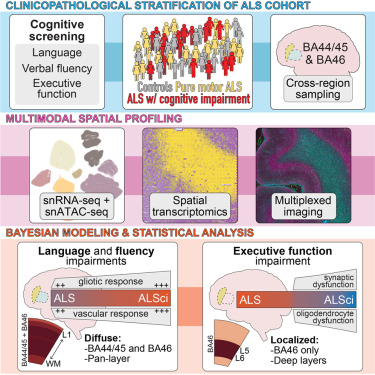
ALS is a fatal neurodegenerative disease. Traditional research has largely focused on limb paralysis symptoms caused by motor neuron damage; however, clinical data show that more than half of patients experience cognitive impairments beyond the motor system, with approximately 35% of patients exhibiting mild cognitive and behavioral abnormalities, primarily manifested as language deficits, executive dysfunction, and apathy. Some patients may further develop frontotemporal dementia (ALS-FTD). For a long time, the pathological mechanisms underlying the different cognitive subtypes of ALS have remained unclear, and it is not known whether the various cognitive decline phenotypes originate from a unified core pathological pathway or from specific molecular interaction abnormalities at the level of brain regions and cells. Moreover, conventional clinical diagnosis and treatment lack a refined cognitive assessment system, and existing studies cannot fully elucidate the pathological changes involving multicellular interactions in the ALS brain. TDP-43 proteinopathy, as a classic pathological hallmark of ALS, also cannot fully explain the individual differences in cognitive impairments among patients. Based on this, the study integrates clinical cognitive stratification phenotypes with multi-omics spatial mapping technology to systematically analyze cellular and molecular abnormalities in the prefrontal cortex of ALS patients, revealing specific cellular phenotypes and pathological mechanisms corresponding to different cognitive decline.

   💬 WhatsApp