
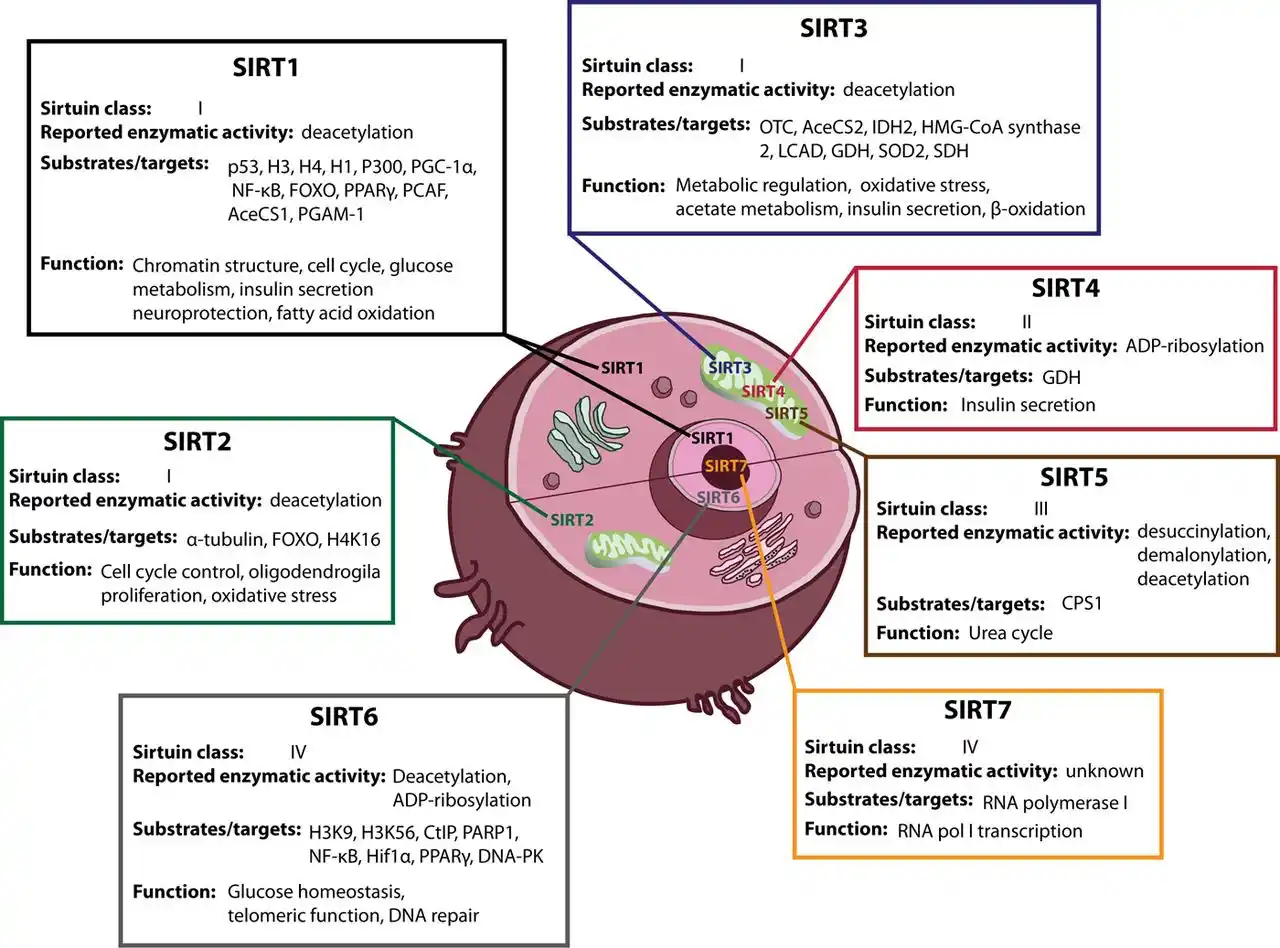
 A common feature of SIRT family proteins is the conserved catalytic core region consisting of approximately 270 amino acids. The sequence between SIRT proteins is conserved and consistent, and the SIRT catalytic core region exhibits a high degree of structural overlap. The catalytic core region includes; (a) a large and structurally homologous Rosmann folding domain with NAD binding protein characteristics; (b) more diverse and smaller zinc‑binding domains in the structure; (c) and loops that connect the Rosmann folding domain with the zinc‑binding domain. These loops form obvious extended cracks between the large and small domains, where NAD and peptide substrates containing acetyllysine enter from the opposite side and bind to the enzyme. The reaction groups of amino acids involved in catalysis and two binding substrate molecules are buried in protein tunnels in the gaps between the two structural domains. The homologous catalytic cores of the seven subtypes of the SIRT family catalyze through the same deacylation mechanism, which is considered the second commonality, including the following processes: (a) NAD and acetyllysine substrate binding; (b) Glycosidic bond cleavage; (c) Acetyl transfer; And the formation of (d) O‑acetyl‑ADPR, nicotinamide, and deacetylated lysine products.
The differences between SIRT family proteins were initially believed to be due to their different subcellular localization. Outside the catalytic core, SIRT proteins have variable N‑ and C‑terminal regions. These regions are not conservative in the protein family, and their length, sequence and secondary structure differ. This will affect the subtype‑specific localization and regulation of proteins (SIRT1 and 2 in the nucleus and cytoplasm; SIRT3, 4, and 5 in mitochondria; SIRT6 and 7 in the nucleus). SIRT1 has the largest expansion in mammalian subtypes, including the N‑terminal STAC binding domain (SBD) and inherent disordered regions. Mitochondria SIRT3, 4, and 5 have very short extensions, especially the N‑terminal mitochondrial localization sequence (MLS). The catalytic activity level of members of the SIRT protein family is their second significant difference. Because the pocket of the active site containing the acyl group of the substrate shows remarkable difference among the subtypes, the subtype specificity of Lys acylation of different proteins is caused. Although there are slight differences in peptide binding slots between subtypes of the SIRT family, this has a relatively small impact on the catalytic activity of each subtype.
SIRT1, 2, and 3 show robust deacetylation activities. SIRT4 and SIRT6 display ADP‑ribosyl transferase activity, used to transfer ADP‑ribose from NAD to the substrate, thus yielding nicotinamide as a product. There are physical and functional interactions between SIRT4 and the components of pyruvate dehydrogenase complex (PDH). The lipase cofactor from the E2 component dihydroacyl lysine acetyltransferase (DLAT) is enzymatically hydrolyzed, which reduces the activity of PDH, thus affecting the glycolysis and tricarboxylic acid cycles. Additionally, SIRT6 prefers long‑chain fatty acylations over acetylations due to a hydrophobic, wider acyl binding region than in other isoforms. Free fatty acids can also bind and activate the deacetylation activity of SIRT6, which may explain the strong in vivo deacetylation activity of subtypes. SIRT5 exhibits enzyme activity mediated by specific Arg for malonylation, succinylation, and glutarylation. SIRT7 shows deacetylation activity and is localized in nucleoli that govern the transcription of RNA polymerase I. Many targets can be modified by SIRTs, including histones and non‑histones. SIRTs participate in a series of cellular metabolism and function regulation by modifying these targets, including inflammation, oxidative stress, mitochondrial function, immune response, and cellular differentiation, proliferation, and metabolism. Overall, the SIRT family plays significant roles in the regulation of cellular function and metabolism.
| Target | Catalog# | Product Name | Reactivity | Application |
|---|---|---|---|---|
| SIRT1 | AMM80879 | SIRT1 Mouse Monoclonal Antibody | Human,Mouse,Rat,Rabbit,Monkey | WB,IHC,ICC,ELISA,FC |
| Phospho‑SIRT1 (T530) | AMRe06007 | Phospho‑SIRT1 (T530) (4C14) Rabbit Monoclonal Antibody | Human | WB |
| Phospho‑SIRT1 (S47) | AMRe06006 | Phospho‑SIRT1 (S47) (2Y6) Rabbit Monoclonal Antibody | Human | WB,IHC,ICC/IF |
| SIRT1 | AMRe21606 | SIRT1 Rabbit Monoclonal Antibody | Human,Rat | WB,IHC,ICC/IF,ELISA,IP |
| SIRT2 | AMM03445 | SIRT2 (1D4) Mouse Monoclonal Antibody | Human,Mouse,Rat | WB,ICC/IF |
| SIRT2 | AMRe02603 | SIRT2 Rabbit Monoclonal Antibody | Human,Mouse,Rat | WB,IHC,IP |
| SIRT3 | AMM81592 | SIRT3 Mouse Monoclonal Antibody | Human | WB,ELISA,FC |
| SIRT3 | AMRe21475 | SIRT3 Rabbit Monoclonal Antibody | Human,Mouse,Rat | WB,IHC,ICC/IF,ELISA,IP |
| SIRT4 | AMM81531 | SIRT4 Mouse Monoclonal Antibody | Human | ICC,ELISA,FC |
| SIRT5 | AMRe83856 | SIRT5 Rabbit Monoclonal Antibody | Human,Mouse | WB |
| SIRT6 | AMM85046 | SIRT6 Mouse Monoclonal Antibody | Human,Mouse,Rat,Monkey | WB,ICC,IP |
| SIRT6 | AMRe02605 | SIRT6 Rabbit Monoclonal Antibody | Human,Mouse,Rat | WB,IHC,ICC/IF,IP |
| SIRT7 | AMM81570 | SIRT7 Mouse Monoclonal Antibody | Human | IHC,ELISA |
Related Products
Super-sensitive ECL chemiluminescent reagent
References
- Sirtuin family in autoimmune diseases. Tao Z, et al. Front Immunol. 2023. [PMID: 37483618]
- Sirtuin activators and inhibitors: Promises, achievements, and challenges. Dai H, et al. Pharmacol Ther. 2018. [PMID: 29577959]
- New assays and approaches for discovery and design of Sirtuin modulators. Schutkowski M, et al. Expert Opin Drug Discov. 2014. [PMID: 24382304]
- The sirtuin family in health and disease. Wu QJ, et al. Signal Transduct Target Ther. 2022. [PMID: 36581622]
- SIRT1 contains N‑ and C‑terminal regions that potentiate deacetylase activity. Pan M, et al. J Biol Chem. 2012. [PMID: 22157016]
- Mitochondrial Sirtuins and Molecular Mechanisms of Aging. van de Ven RAH, et al. Trends Mol Med. 2017. [PMID: 28285806]
- Sirtuin 4 is a lipoamidase regulating pyruvate dehydrogenase complex activity. Mathias RA, et al. Cell. 2014. [PMID: 25525879]
- Sirt5 is a NAD‑dependent protein lysine demalonylase and desuccinylase. Du J, et al. Science. 2011. [PMID: 22076378].
- Structure and biochemical functions of SIRT6. Pan PW, et al. J Biol Chem. 2011. [PMID: 21362626].
- SIRT7 links H3K18 deacetylation to maintenance of oncogenic transformation. Barber MF, et al. Nature. 2012. [PMID: 22722849]
- Sirtuin catalysis and regulation. Feldman JL, et al. J Biol Chem. 2012. [PMID: 23086947]