
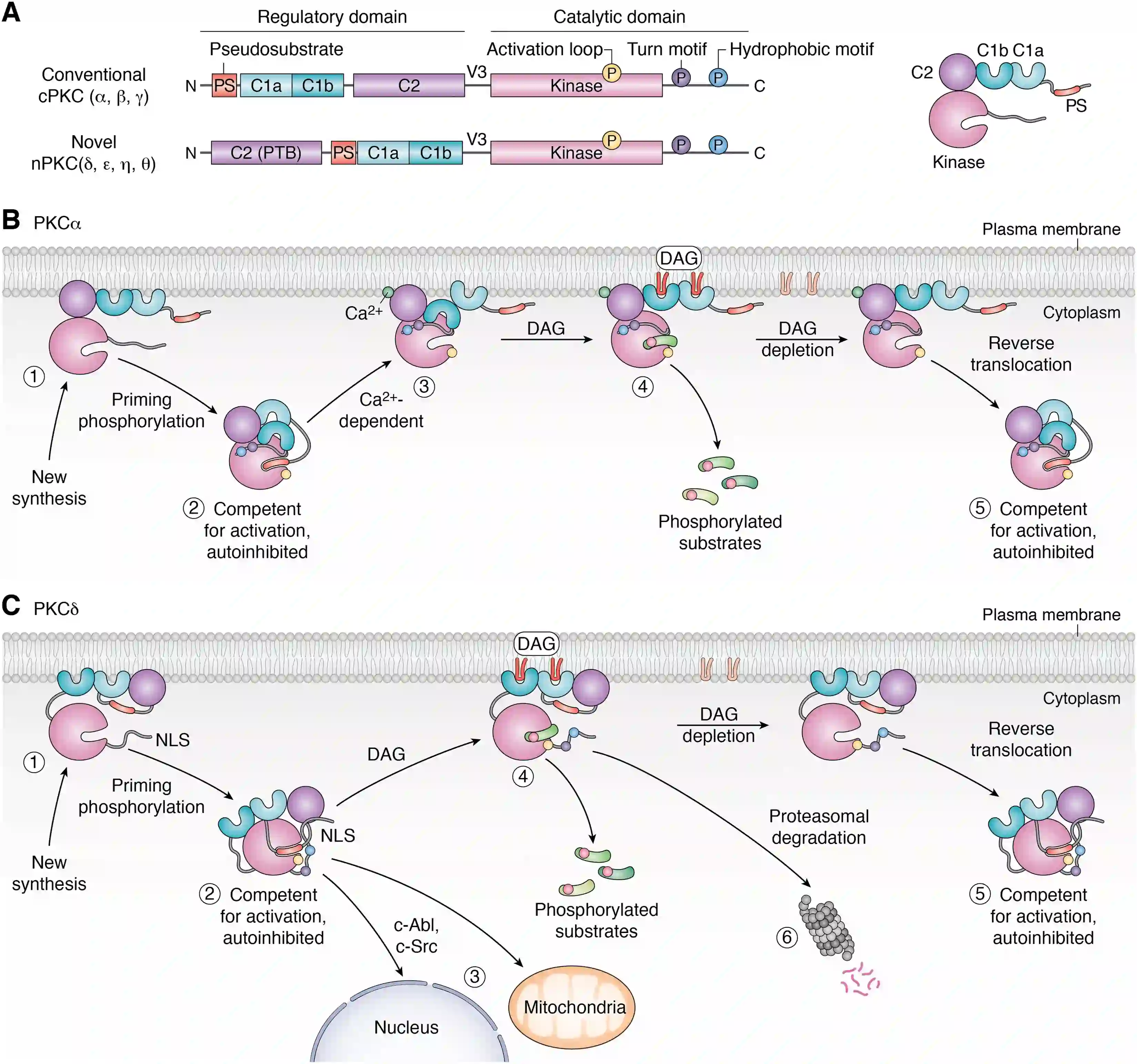
 Activation of protein kinase C (PKC) is one of the earliest events in a cascade that controls a variety of cellular responses, including secretion, gene expression, proliferation, and muscle contraction. PKC isoforms belong to three groups based on calcium dependency and activators. Classical PKCs are calcium‑dependent via their C2 domains and are activated by phosphatidylserine (PS), diacylglycerol (DAG), and phorbol esters (TPA, PMA) through their cysteine‑rich C1 domains. Both novel and atypical PKCs are calcium‑independent, but only novel PKCs are activated by PS, DAG, and phorbol esters. Members of these three PKC groups contain a pseudo‑substrate or autoinhibitory domain that binds to substrate‑binding sites in the catalytic domain to prevent activation in the absence of cofactors or activators. Control of PKC activity is regulated through three distinct phosphorylation events. Phosphorylation occurs in vivo at Thr500 in the activation loop, at Thr641 through autophosphorylation, and at the carboxy‑terminal hydrophobic site Ser660. Atypical PKC isoforms lack hydrophobic region phosphorylation, which correlates with the presence of glutamic acid rather than the serine or threonine residues found in more typical PKC isoforms. The enzyme PDK1 or a close relative is responsible for PKC activation. A recent addition to the PKC superfamily is PKCμ (PKD), which is regulated by DAG and TPA through its C1 domain. PKD is distinguished by the presence of a PH domain and by its unique substrate recognition and Golgi localization. PKC‑related kinases (PRK) lack the C1 domain and do not respond to DAG or phorbol esters. Phosphatidylinositol lipids activate PRKs, and small Rho‑family GTPases bind to the homology region 1 (HR1) to regulate PRK kinase activity.
| Target | Catalog# | Product Name | Reactivity | Application |
|---|---|---|---|---|
| PKC alpha | AMRe83743 | PKC alpha Rabbit Monoclonal Antibody | Human,Mouse,Rat | WB,IHC,ICC/IF,ICC,FC,IP |
| PKC zeta | APRab00384 | PKC zeta Rabbit Polyclonal Antibody | Human,Mouse,Rat,Monkey | WB,IHC,ICC/IF,ELISA |
| PKC | AMRe84446 | PKC Rabbit Monoclonal Antibody | Human,Mouse,Rat | WB,IHC,ICC/IF,ICC,FC,IP |
| PKC γ | APRab16201 | PKC γ Rabbit Polyclonal Antibody | Human,Mouse,Rat | WB,IHC,ICC/IF,ELISA |
| PKC θ | APRab16205 | PKC θ Rabbit Polyclonal Antibody | Human,Mouse,Rat | WB,IHC,ICC/IF,ELISA |
| Phospho‑PKC alpha (Ser657) | AMRe04115 | Phospho‑PKC alpha (Ser657) Rabbit Monoclonal Antibody | Human,Mouse,Rat | WB,IHC |
| Phospho‑PKC gamma (Thr514) | AMRe04098 | Phospho‑PKC gamma (Thr514) Rabbit Monoclonal Antibody | Human,Mouse,Rat | WB,IHC,IP |
| Phospho‑PKC zeta/lambda (Thr410/Thr412) | AMRe02866 | Phospho‑PKC zeta/lambda (Thr410/Thr412) Rabbit Monoclonal Antibody | Human,Mouse | WB,IHC |
| PKC delta+PKCtheta | AMRe84187 | PKC delta+PKCtheta Rabbit Monoclonal Antibody | Human,Mouse,Rat | WB,IHC,ICC/IF,ICC |
| Phospho‑PKC gamma (Thr514) | AMRe84874 | Phospho‑PKC gamma (Thr514) Rabbit Monoclonal Antibody | Human,Mouse,Rat | WB,IHC,IP |
| PKC β | APRab16200 | PKC β Rabbit Polyclonal Antibody | Human,Mouse,Rat | WB,ICC/IF,ELISA |
| Phospho‑PKC delta (Ser299) | AMRe02865 | Phospho‑PKC delta (Ser299) Rabbit Monoclonal Antibody | Human | WB,IHC,IP |
| Phospho‑PKC (Ser660) | AMRe84931 | Phospho‑PKC (Ser660) Rabbit Monoclonal Antibody | Human,Rat | WB,IHC |
| PKC beta 1 | AMRe16192 | PKC beta 1 (9E18) Rabbit Monoclonal Antibody | Human,Mouse,Rat | WB,IHC,ICC/IF,FC |
| PKC epsilon | AMRe16194 | PKC epsilon (3H3) Rabbit Monoclonal Antibody | Human,Mouse,Rat | WB,IHC,ICC/IF,FC |
| PKC beta 2 | AMRe16193 | PKC beta 2 (12R10) Rabbit Monoclonal Antibody | Human,Rat | WB,IHC,ICC/IF,FC,IP |
| Phospho‑PKC alpha (Thr638) | APRab03728 | Phospho‑PKC alpha (Thr638) Rabbit Polyclonal Antibody | Human,Mouse,Rat | WB,IHC,ICC/IF,IP |
| PKC eta | AMRe02447 | PKC eta Rabbit Monoclonal antibody | Human,Mouse,Rat | WB,IP |
| DNA PKcs | AMRe21286 | DNA PKcs Rabbit Monoclonal Antibody | Human,Mouse,Rat | WB,IHC,ICC/IF,ELISA,IP |
| Phospho‑PKC delta(Y311) | AMRe84366 | Phospho‑PKC delta(Y311) Rabbit Monoclonal Antibody | Human | WB,IHC,IP |
| Phospho‑PKC alpha (Thr497) | AMRe87675 | Phospho‑PKC alpha (Thr497) Rabbit Monoclonal Antibody | Human,Mouse,Rat | WB,IHC |
| PKC δ | AMRe21275 | PKC δ Rabbit Monoclonal Antibody | Human,Mouse,Rat | WB,IHC,IF,ELISA |
| Phospho‑PKC θ (Thr538) | APRab05268 | Phospho‑PKC θ (Thr538) Rabbit Polyclonal Antibody | Human,Mouse,Rat | WB,IHC,ICC/IF,ELISA |
| Phospho‑PKC θ (Ser695) | APRab05267 | Phospho‑PKC θ (Ser695) Rabbit Polyclonal Antibody | Human,Rat,Mouse | WB,IHC,ICC/IF,ELISA |
| Phospho‑PKC θ (Ser676) | APRab05266 | Phospho‑PKC θ (Ser676) Rabbit Polyclonal Antibody | Human,Mouse,Rat | WB,IHC,ICC/IF,ELISA |
| Phospho‑PKC ζ (Thr560) | APRab05265 | Phospho‑PKC ζ (Thr560) Rabbit Polyclonal Antibody | Human,Mouse,Rat,Monkey | WB,IHC,ICC/IF,ELISA |
| Phospho‑PKC ζ (Thr410) | APRab05264 | Phospho‑PKC ζ (Thr410) Rabbit Polyclonal Antibody | Human,Mouse,Rat | WB,IHC,ICC/IF,ELISA |
| Phospho‑PKC ε (Ser729) | APRab05263 | Phospho‑PKC ε (Ser729) Rabbit Polyclonal Antibody | Human,Mouse,Rat | WB,IHC,ELISA |
| Phospho‑PKC δ (Tyr64) | APRab05262 | Phospho‑PKC δ (Tyr64) Rabbit Polyclonal Antibody | Human,Mouse,Rat | WB,IHC |
| Phospho‑PKC δ (Tyr52) | APRab05261 | Phospho‑PKC δ (Tyr52) Rabbit Polyclonal Antibody | Human,Mouse,Rat | WB,IHC,ICC/IF,ELISA |
| Phospho‑PKC δ (Tyr313) | APRab05260 | Phospho‑PKC δ (Tyr313) Rabbit Polyclonal Antibody | Human,Mouse,Rat | WB,IHC,ICC/IF,ELISA |
| Phospho‑PKC δ (Thr507) | APRab05259 | Phospho‑PKC δ (Thr507) Rabbit Polyclonal Antibody | Human,Mouse,Rat | WB,IHC,ICC/IF,ELISA |
| Phospho‑PKC δ (Ser645) | APRab05258 | Phospho‑PKC δ (Ser645) Rabbit Polyclonal Antibody | Human,Monkey | WB,IHC,ICC/IF,ELISA |
| Phospho‑PKC β (Ser661) | APRab05257 | Phospho‑PKC β (Ser661) Rabbit Polyclonal Antibody | Human,Mouse,Rat | WB,IHC,ICC/IF,ELISA |
| Phospho‑DNA‑PKCS (Thr2647) | APRab04555 | Phospho‑DNA‑PKCS (Thr2647) Rabbit Polyclonal Antibody | Human,Rat,Mouse | WB,IHC,ICC/IF,ELISA |
| Phospho‑DNA‑PKCS (Thr2638) | APRab04554 | Phospho‑DNA‑PKCS (Thr2638) Rabbit Polyclonal Antibody | Human,Mouse | ICC/IF,ELISA |
| Phospho‑DNA‑PKCS (Ser2612) | APRab04553 | Phospho‑DNA‑PKCS (Ser2612) Rabbit Polyclonal Antibody | Human,Rat,Mouse | IHC,ICC/IF,ELISA |
| Phospho‑DNA‑PKCS (Ser2056) | APRab04552 | Phospho‑DNA‑PKCS (Ser2056) Rabbit Polyclonal Antibody | Human,Mouse | WB,IHC,ICC/IF,ELISA |
Related Products
Super-sensitive ECL chemiluminescent reagent
References
- The role of protein kinase C in cell surface signal transduction and tumour promotion. Nishizuka Y. Nature. 1984. [PMID: 6232463]
- Protein kinase C is regulated in vivo by three functionally distinct phosphorylations. Keranen LM, et al. Curr Biol. 1995. [PMID: 8749392]
- The extended protein kinase C superfamily. Mellor H, et al. Biochem J. 1998. [PMID: 9601053]
- New insights into the regulation of protein kinase C and novel phorbol ester receptors. Ron D, et al. FASEB J. 1999. [PMID: 10506570]
- The atypical protein kinase Cs. Functional specificity mediated by specific protein adapters. Moscat J, et al. EMBO Rep. 2000. [PMID: 11258478]
- Role of diacylglycerol in PKD recruitment to the TGN and protein transport to the plasma membrane. Baron CL, et al. Science. 2002. [PMID: 11729268]
- Rho GTPase control of protein kinase C‑related protein kinase activation by 3‑phosphoinositide‑dependent protein kinase. Flynn P, et al. J Biol Chem. 2000. [PMID: 10753910]
- PKCα and PKCδ: Friends and Rivals. Black JD, et al. J Biol Chem. 2022. [PMID: 35760100]